Mourning a Mother: experiences & institutions
April 28th, 2026Revised version of Mourning a Mother: between experience and institution.
For the symposium Arbeid, Migratie, Exclusie, voorbij de cijfers. Implicaties voor de Psychiatrie, at the Spring Congress of NvvP 2026.

A sanctuary, a view of Dutch coastal dunes with towers of The Hague peeking from behind.
I’m invited to speak before you as an ervaringsdeskundige, a role and a term that, if I’m right, has a longer and a more established history in the Netherlands than in the English-speaking world. My friend Huub Beijers, surprised me just a few days ago with the fact of his involvement in developing this concept in the Netherlands. He gave me the understanding that ervaringsdeskundigheid prescribes the movement from ervaring/experience to deskundigheid/expertise via collective processes organized by persons with similar experiences, turning experience into knowledge. I have not been through that process and so I am not legitimately an ervaringsdeskundige. But there are interesting complications of this concept that I will gladly harness to hopefully satisfy you today with something else, something with the following shape: that when we hear about someone’s “lived experience” there is always already something of (formal) institutions in that process. Institution is not something that comes after lived experience. Just as Peter Pentevogel showed us with his forays into refugees’ lives, that when medics and assistants come to intervene in their lives, they witness that they’re not just living a bare life in tent, but that these tents have been instituted for institutionally recognised refugees for decades, I mean, for generations of their families. History of people with institutions should be part of considering their conditions, something resembling “institutional transference”, implying a countertransference.
Things get complicated quickly indeed in the case of ervaringsdeskundigheid, especially when I start speaking of “expert from experience”–because what else would make you an expert except certain qualified experiences? And well, what does it mean to speak in English of lived experience but in the context of an academic symposium in English for Dutch psychiatrists? Don’t you go back (down) to listen to what your patients say in their language? Why does there seem to be this insurmountable divide between institution and life, as between expertise and experience, between academic-professional English and spoken language of “clients”? In my case, with what language should I speak of my lived experience in this professional context so that I can be heard? Or is it up to you to recognize my idiosyncratic expressions using your professional categories that you are sure already can accommodate my story?
I’m not here for such questions of course, but I’m glad I can wrestle with them a little bit in your presence. As a student of feminism who finds explication of “positions” necessary, I believe we all wrestle with position-taking in our institutional lives, but perhaps not so explicitly and collectively, for example when we have to decide between calling out our boss for workplace toxicity or ask for a “burnout” and make ourselves further responsible. Which position will you take? Even the dilemma of labelling yourself burnout is further tiring you out. And this is not even a “moral stress” because the choice is not moral choice (you know which is morally upright). It is institutional and livelihood/existential stress, because either choice will cost you a lot of your life. You see, how institution is not always on your side even when you have chosen to be on its side?
Aren’t things indeed always mixed or convoluted like that? And isn’t it thanks to these mixtures, these complications that we can nevertheless speak to each other? I guess I’m not too far afield in mixing “experience and expertise”, and “life and institution” up a little. I’ve seen in the programme of the Congress, seminars for psychiatrists sharing their struggles they have with their own mental health; some lived experience added to their other experience. This helps me relate to you and trust you with my story, just as it helps to know you’ve gone through self-analysis, & never skip intervision (fingers crossed).
Feeling a bit free then, I complicate “experience” by speaking about my mother instead of talking directly about myself. More precisely, I speak of my life through speaking of her passing away, her dying and her death, and her life as a symbol of the complex of institutions shaping lives and deaths. Various institutions will glimpse through this personal story, sometimes positive, sometimes negative. Above all, I hope I can open you up to the possibility, that we can be certain of institutions’ influential role in our lives and deaths, even if these roles are not acknowledged by experts; they may be even impossible to translate into “knowledge” and legitimate institutional language.
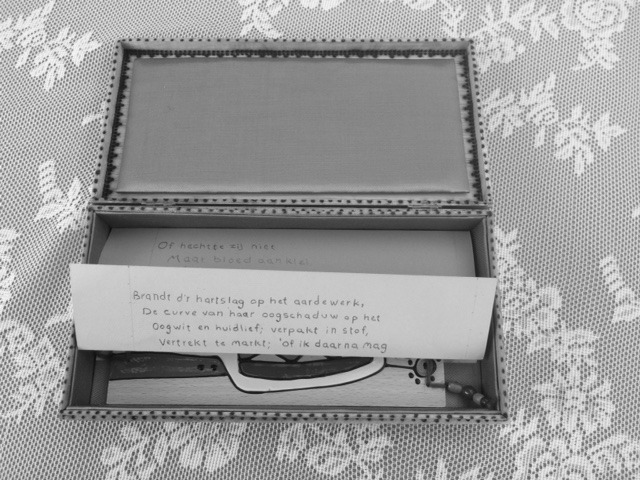
So, here we are, a piece of my mother has come with me. (Poetically speaking.) A small pair of decorative Persian handicraft shoes. I planted them somewhere specific in the coastal dunes, creating a low-key sanctuary, making a place away from home I can visit her when I choose myself, so she doesn’t bother me in my sleep. — She passed away last year in April, exactly a month after the Persian new year and meteorological Spring, and a few weeks before Israel bombed Tehran, where she used to live. And it is after that that I started being more in touch with her. The fact of her passing made me think that now more of her could be here than before, when she used to be bound to her body. If her flesh and blood were quintessential to her life, as with anybody,… in her case, it also meant that I had to put front and centre the words that came out of her mouth and typing fingers—this, more than the things I wanted her to say. What she had to tell me for the last 12 years or so has been most strictly limited to dietary advice and precautions, and the occasional “don’t trust this” and “that.” For example, during the pandemic this was “don’t vaccinate.” and “drink this to cleanse yourself.”

Above any other feeling, this irritated me. I never discovered a good meaning for that irritation. Why would an intelligent woman like her end up fixating on those matters in that way? Would the same happen to me with age? It was unhealthy behaviour for sure. But more than that, it meant that we couldn’t speak of other, maybe even more painful things: my questions about her social and mental conditions, or about our family’s past, her marriage (if not love) story, things that would help me understand my own biography. It meant furthermore that I couldn’t elicit a sense of having a mother, except only through such skewed and compulsive remarks as “squeeze a little lemon into your morning room-temperature glass of water.” She meant of course “I still care about you, even if I no longer know if and what kind of care you need.” Such an expression, wouldn’t be less painful than the indirect messages. I did know this meant she was suffering in many ways, but how these things pained me, figured more decisively in my relating to her than her pain.
Over the years I moved in the direction of minimizing our communication, as you would do in dealing with a source of allergy and nuisance. I could have travelled to Tehran. I never did. Maybe if I had the feeling of having settled here, of having a solid base, then I may have felt able to go on a difficult outward journey like that of seeing the gradual destruction of the lives of my mother and other relatives over there! If only I had chosen for income security over and above my own nomadic intellectual curiosities; only if I had taken my (inherited) anti-capitalist, anti-imperialist stance with some or more grains of salt! Alas, I didn’t succeed. And in the extended family it was never expected of me to be otherwise. That is, from childhood on I was never involved in family decisions and never identified with it.
I was called 8 days after she passed. The autopsy, (she wouldn’t have consented to it) said she had suffered cervical cancer. The 8 gap days marked, then most definitively, what kind of a relationship to family was ever expected of me.
Had this minimal and remote relationship now ended? Was it time to “let go” of any last bits of my mother? With my father’s funeral, which I had single-handedly organised a few years prior (he and I were the only family members living here) I knew that I had to go through the farewell carefully. I had learnt that incomplete mourning could later return to haunt me. I had also learnt that everyone dies differently and that mourning over one person cannot be extended in any simple way to another, at least, not for a migrant, away from the dead. I didn’t and couldn’t touch her cold skin to realise in my own body that she was gone. The fact that I hadn’t touched her body for decades (and also had lost touch to her verbal intelligence) meant that significant parts of her were already gone for me, without an event, without goodbye, without the possibility of marking what is lost. One usually loses twice, the thing and knowing what is lost. Was I mourning before her death? Did her death end my mourning?
Neither would there be a commemoration of her after the event of her passing: there’s no one around me to share memories of my mother. Advantage: no municipality to write me dryly that I have to pay the unpaid fines of diseased. No gathering around her no-longer-existing spirit. She’s hasn’t been here and so over here she’s exists even less than the dead person over in Tehran. How could I keep a notion of her alive if nothing in my surroundings makes me speak of her? No, it’s a bit worse—when things do remind me of her, for example when friends start mentioning their own mothers in any way, or ask about my family, things are rather hurtful, or impress me as distant & cloudy. I feel either an emptiness, or pain, both reasons for falling silent. Whenever family comes up in conversations, people find me empty and impersonal. Or heavy when I do speak. Frequently, they grow silent towards me, just as they do with romance, with work, and with travelling. Food is one of things left to talk around!
Naturally, I was about to “let go” of my mother even more, whose name cut me from others more than it would connect. But, when I went back to a book by my go-to-philosopher, Vinciane Despret (Au bonheur des morts, English translation: Our Grateful Dead), on this matter I was reminded that “letting go” is a modern conception in contrast to which Despret lists cases of Europeans, “those left behind”, who, instead of letting go, have formed new relationships with their dead loved ones. Lucky was I to be in touch with this unknown strain of European/French philosophy & anthropology, thanks to my academic education and uncommon choice of discipline! If at first I thought of designing and conducting an alternative ritual to “let go”, now, with a sigh of relief, I told myself, that there was indeed no need for this letting go at all. She could come and stay! No Dutch ministry would have a say in that now!
I devised an affordable way for myself to welcome my mother here, now that “she was free to move.” That is, now that my memories of her stopped leading me towards the desperate and powerless concern for what was left of her, and towards my own powerlessness and lack of responsibility. Indeed, her liberation, liberated me. I could not have liberated myself, with any amount of one-sided therapy, without her liberation.

I went through the ritual of welcoming my mother in the Netherlands, something that I shaped thanks to conversations with friends, through some women in life, and also thanks to some institutions and despite some other. I can say that this very ritual made it possible that I can speak of her, for example, today, to turn her isolated node and name into a connection. Just last week I brought two Easter eggs to the sanctuary I had enshrined last year. I left one real egg there and brought the plastic one back because I couldn’t leave that there, noticing then that I had multiplied the nodes in the web a bit further since this egg would need a place closer to my place (naturally it doesn’t go to trash). What an advantage Easter eggs have, being of April, of Spring, and of new life!
Easter is some weeks before her day of passing. This too is meaningful: I told you I was not called on the day she passed. This parallels my losing her over a long stretches, not one day, more gradually and more insidiously. The day of her passing is a bureaucratic fact from my distance. So, I’m happy to memorialise her around this date. Connect her to the Spring, to calendars, to Easter. This amounts to creating an intricate web, not yet maybe a “narrative matrix” as Despret calls it. But I can tell you, I speak of her more! And at least my example of Easter eggs, will suggest to you that I’ve hopefully succeeded in making her commemoration not only a recurrent event but also making it affordable thanks to the religious institution of the Easter that has in it already its free days, good weather, as well as marks of suffering, resurrection, fertility and new life.
And just as much, Her life is connected to war and violence.
My mother, her name was Susan. She was a petrochemical engineer, one of the few women who chose and was admitted for technical studies when Iranian universities opened their doors to women. The same intelligence, mixed with her gender, made her distrustful of others. The revolution, its co-optation by Islamic factions, the political murders and executions, among others of people she knew, and the years of war and pounding down on dissidents, the masculine culture of both public and private (petrochemical) companies, her own disdain and fear for the lesser education of my dad, and stupidity and violence of most men,… and the later years, the overall Western economic sanctions targeting the Iranian economy and its consequences for job markets, for food prices, all contributed to a paranoid life in poverty, and isolation. I cannot comprehend her pain, somatic and psychical, without these factors. Her message of “don’t trust” wouldn’t make sense. Her petrochemical background and dietary paranoia are connected through her love for chemistry and her reduction to a woman, a gender, with mere second-hand vote over what lands on her plate.
It is partly through her life that I’ve understood violence better than the shallow images through which we get to know them (or get to dissociate them). Violence, the silent word lurking from behind Poverty, Migration, & Exclusion. When after June last year an American friend told me “I’m sorry for what my country is doing to your country” I replied spontaneously: “the bombs are just the most visible part of what has been going on for much longer”, I thought of my mother’s elongated dying. –Medical anthropologist and doctor Didier Fassin attests to this real relationship between bombs and other forms of violence. He says:
in the real social world, the violence of the state can take various often less explicit forms—from restricting social protection through budget cuts in the public health care system, as in the United States, to brutal repression by the police against peaceful demonstrators, as in Egypt.
(from his article The Trace: Violence, Truth, and the Politics of the Body, in Social Research, 2011, 78(2))
(We would need 5 Didier Fassins for every life to produce legitimate discourses on invisibly perpetrated violence.) It is through these anthropological insights, produced by those who have survived the neoliberalization of universities, that I can imagine together the political reality, and the real bodily pain behind her deflective way of communicating. But this very academic generalization of my thinking, its germs, I have received from my mother as much as university life. She had a sense that her suffering was political and economic. She knew it since the revolution of 1979, form circles where they read Das Kapital. In the decades after she could not maintain an informed and intellectual connection to sources of knowledge that would help her more properly articulate the forces that shaped/violated her life. One can never meet and get a signed declaration from those people, usually behind desks, who stir in the soup of our lives often without our consent. But their existence is undeniable and our distrust (our institutional transference), even when lacking legitimate knowledge, demands to be respected.
Thanks to these realisations, even if in sorrow, I can say that we are both convinced that our conditions are political and our suffering is collective. My mother, if in what she couldn’t be for me, connected me to the world, and her pain gives me be capacity to be in compassion with other mothers—and non-mothers.
Expertise is more valuable than experience. No doubt. It is experience made accountable. But experience itself is of the order existence, of survival. Of ontology. Non-articulated or badly articulated experience should not elicit disapproval by epistemic authorities. It commands dignity. If pain silences one’s voice, then even silence, lacking potential for knowledge still needs good ears.
The message behind this is maybe, that the question of epistemic legitimacy of those who are not proper citizens (the poor, the migrant, the excluded, the deviant) is a question of legibility, more than of their epistemic credibility. Is this legible for me? Do I hear you well? Do I get your pain/ passion/ pathos/ lijden/ belijdenis? And here the burden is divided between both the speaker and the listener, and in the case of a profession like psychiatry, perhaps a bit more on the side of the listener. And one important condition for legibility that I see in my story of my mother, is that lived experience always be seen in their entanglement with institutions. This is the lesson from my philosophical discipline which I don’t dissociate from my personal conviction.
I apologize that translating this into “implications for psychiatry” demands much work. My hope is that these implications will involve complications, much more than simplifications. If in psychiatry one cannot work but through statistically categorizing people (though I do know psychiatrists who do otherwise, see for example Tobie Nathan and Isabelle Stengers’ Médecins et sorciers, English translation Doctors and Healers), then complications, like “institutional transference”, might help with hearing the persons through the category, without also falling from the other side, of complete individuation, of dissociating their lives from their so-called biopolitical conditions. Thank you for this opportunity to speak and thank you for listening.